
November 1, 2026
Epson I3200 vs I1600 vs F1080 for DTF: Nozzles, Speed & Which Head in Canada
If you are comparing I3200 vs I1600 — or staring at an Epson F1080 / XP600 quote — you are not shopping for a random spare part. The printhead decides how many nozzles fire per pass, how fast film leaves the dryer, and whether your next replacement is a PrecisionCore industrial head or a different Micro Piezo platform.
Canadian shops call us about this every week because the wrong answer means either overpaying for speed you never use, or under-buying a head that cannot keep up with Friday rush. This guide uses Epson’s published I-series specs (PrecisionCore MicroTFP) and the real F1080 / XP600 architecture difference, then maps each head to what we stock in Ottawa.
Quick answer (then the proof)
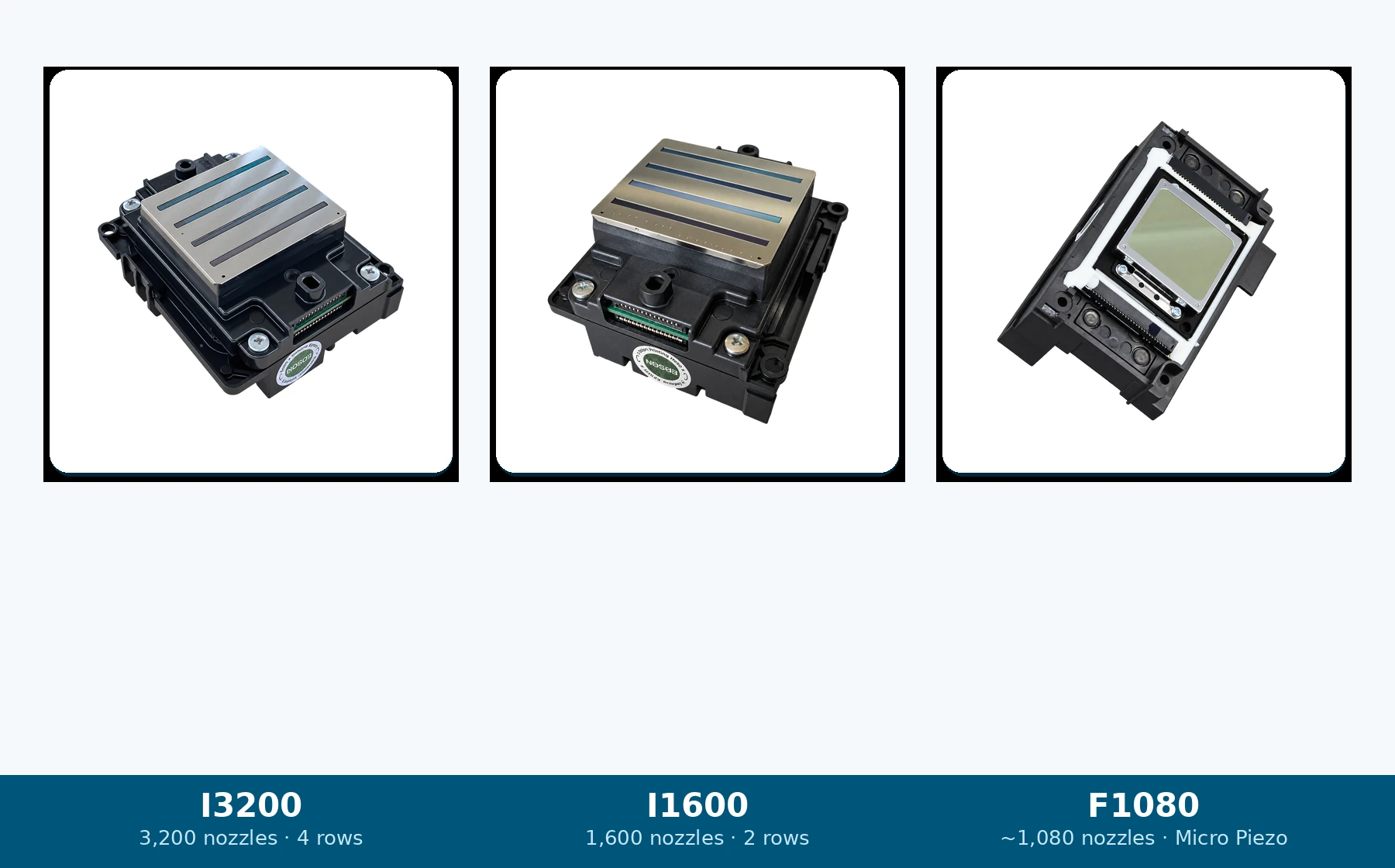
- Epson I3200 — PrecisionCore MicroTFP, 3,200 nozzles (8channels/2 channels per color/4rows). Production pick when daily volume justifies the head.
- Epson I1600 — same PrecisionCore MicroTFP technology, 1,600 nozzles (4channels/1 channels per color/2rows). Same droplet language, lower throughput per pass — the mid commercial option.
- Epson F1080 (XP600 family) — different technology: desktop-derived Micro Piezo / MACH-style head (~1,080 nozzles, ~180 npi/row). Cheaper parts path when the chassis was built for it — not an “I-series lite.”
Spec sheet: what actually differs
Figures below for I3200(4) / I1600 come from Epson’s I-series product data (PrecisionCore MicroTFP). F1080 / XP600 values are the industry-standard layout used on entry DTF platforms (6 × 180 nozzles).
| Spec | I3200 | I1600 | F1080 (XP600) |
|---|---|---|---|
| Technology | PrecisionCore MicroTFP (MEMS / thin-film piezo) | PrecisionCore MicroTFP (same family) | Micro Piezo (different platform) |
| Nozzles | 3,200 | 1,600 | ~1,080 |
| Nozzle rows | 8 | 4 | 6 |
| Nozzle pitch / resolution | 1/300″ · 300 npi/row · 600 npi / 2 rows | 1/300″ · 300 npi/row · 600 npi / 2 rows | ~1/180″ · ~180 npi/row · ~360 npi / 2 rows |
| Effective print width | 33.8 mm (1.33″) | 33.8 mm (1.33″) | ~25.4 mm (1″) |
| Max colours (head) | 4 (I3200(4)); HD-8 variants for 8 colors | 4 | Up to 6 channels/channels (often remapped CMYK+W) |
| DTF role | Serious production speed | Same image tech, lower speed | Budget / chassis-matched spare |
Source: Epson Inkjet Solution I-series datasheet / product page for I3200 & I1600 nozzle counts and PrecisionCore type; F1080 row reflects the widely published XP600 / F1080 nozzle map used on DTF entry printers.
Epson I3200 — 3,200 nozzles for serious DTF production
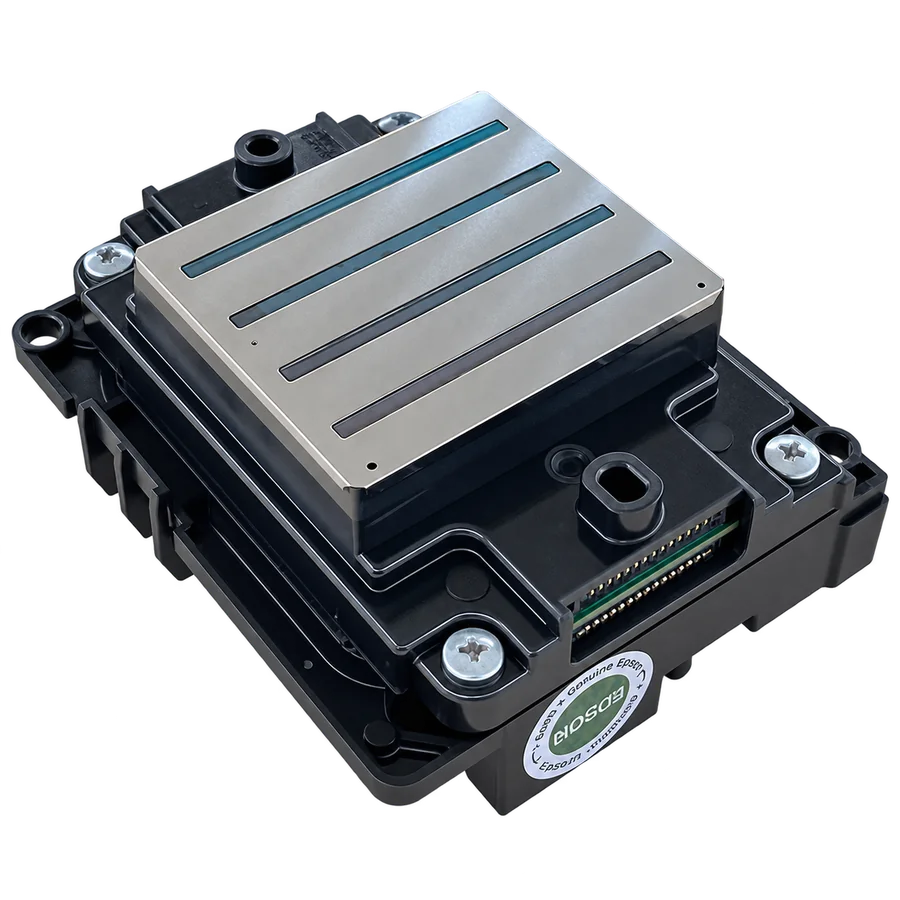
The Epson I3200 is Epson’s high-density I-series head for aqueous (A1), UV (U1), and eco-solvent (E1) chemistries. Officially it is a PrecisionCore MicroTFP printhead with 3,200 nozzles across 8 channels, 400 npi per row (600 npi when two rows combine), and a 33.8 mm effective print width.
Why shops feel the difference on film: more nozzles in the same 1.33″ swath means more ink per carriage pass. On a busy apparel line that shows up as fewer passes (or higher carriage productivity) before the powder shaker and dryer become the bottleneck — not as a different “look” of droplet. Epson’s Variable Sized Droplet Technology (VSDT) greyscale behaviour is part of the same PrecisionCore family as the I1600.
Need multi-channel industrial layouts? Confirm whether your manifold wants standard I3200(4) or an I3200 A1 HD 8 configuration before you order. Printheads are final sale — call Ottawa first.
Epson I1600 — same PrecisionCore tech, 1,600 nozzles, lower speed
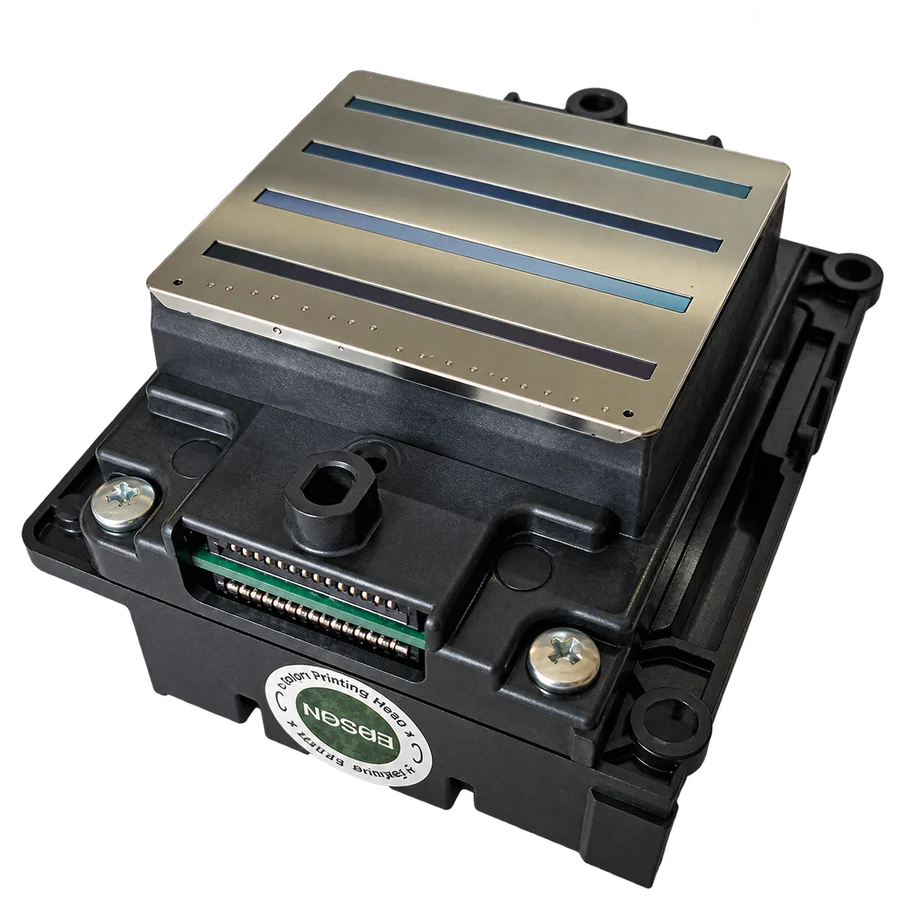
The Epson I1600 A1 is not a “cheaper chip with softer dots.” Epson lists it as the same PrecisionCore MicroTFP type, same body envelope (~69.1 × 59.5 × 35.6 mm), same 33.8 mm print width, same 300 npi/row pitch — with half the nozzles (1,600 in 4 rows).
That is the real I1600 vs I3200 story: identical core technology, lower nozzle count → lower ink delivery per pass → lower practical print speed on the same RIP and pass mode. Image sharpness and greyscale language stay in the same family; throughput does not. Compact and mid-width Canadian installs often land on I1600 because the chassis, headboard, and budget were designed around it — and the print quality still looks commercial.
UV is a different ink path: use the I1600 U1 UV, not the water-based A1. Mixing UV and apparel aqueous heads/inks is how shops create expensive downtime.
Epson F1080 — different technology (XP600 family)
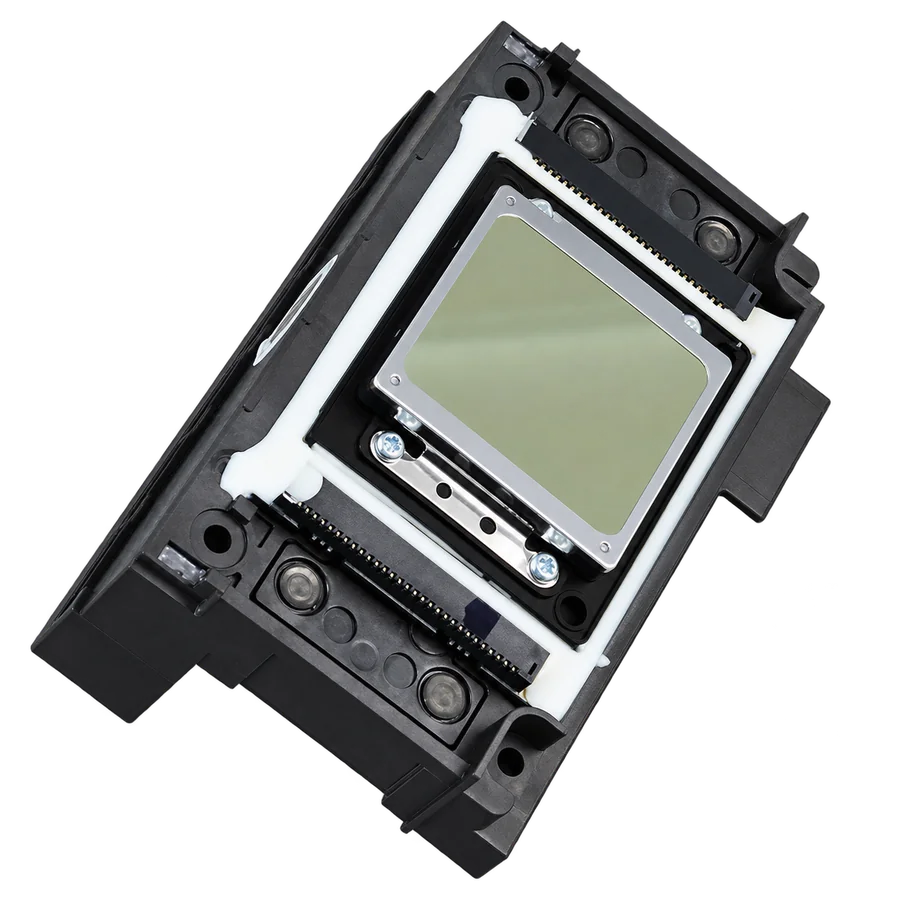
The Epson F1080 (XP600) sits on a different technology stack. It is the industrial-facing name for the XP600-class Micro Piezo head that powered consumer photo printers and was adapted into countless entry DTF machines. Typical layout: ~1,080 nozzles (6 channels × 180), ~180 npi per row, ~1″ effective width — denser marketing numbers on the box do not make it an I3200.
Choose F1080 when your printer was designed around F1080 / XP600 and you need an original replacement (we stock originals, not refurbished XP600s) at a lower parts cost. Do not treat it as a drop-in “upgrade path” to I1600/I3200: carriage boards, dampers, capping, FCC cables, and firmware are family-specific. Wrong-head swaps are a common Canada shipping regret.
How Canadian shops should decide
- Daily apparel volume / production printers — Prefer I3200-class engines from our DTF printers Canada hub. You are buying nozzle count and duty cycle, not a different “brand of Epson.”
- Growing shop already on I1600 — Stay on I1600 until film/ink volume and labour prove you need more passes per hour. Same PrecisionCore quality; add capacity with a second machine or an I3200 chassis, not a frankenstein head swap.
- F1080 / XP600 chassis on a tight budget — Keep F1080, protect it with good ink fluidity, dampers, and capping that match the head. Read Best DTF Printer in Canada (2026) before you buy a whole new platform.
Ink, dampers, and what we stock with each head
Our Ultra Premium (UP) DTF inks are engineered for Epson i1600, i3200, and F1080 chemistries so restock stays simple across the three platforms we support. Browse the DTF inks hub, then match dampers / capping / FCC parts from the parts hub to the exact head family — I-series dampers are not F1080 dampers.
Maintenance rule that saves heads: climate in a sensible shop range, white ink recirculation habits your RIP expects, and Ottawa on the phone for installs instead of improvising torque on a $1,000+ consumable.
What to order next
- Confirm the head stamped on your carriage (I3200, I1600 A1, I1600 U1, or F1080).
- Open the matching product page and add the correct dampers / cables if you are replacing a head.
- Pair film from the films hub and a package quote from the supplies hub.
- Call 343-882-6226 if anything is unclear — shipping the wrong printhead is expensive.
Shop I3200 → · Shop I1600 → · Shop F1080 → · Browse printers →
Technical sources: Epson Inkjet Solution — I-series product specifications (I3200: 3,200 nozzles / PrecisionCore MicroTFP; I1600: 1,600 nozzles / same PrecisionCore MicroTFP; shared 33.8 mm width and 300 npi/row). F1080 / XP600 Micro Piezo nozzle map as used on entry DTF platforms. Shop-floor speed also depends on passes, white laydown, shaker, and dryer — nozzle count is the head’s contribution, not the whole line.
Comments
Ask a practical question or share what worked in your shop. Comments are moderated before they appear.
- No public comments yet — be the first.